

783 original hands-on activities for kids (as well as a compiled archive of ideas from all over the web) with a strong focus on inquiry, design thinking, problem-solving skills, imaginative / creative thinking, nature, drama, learning with movement, music, arts integration and PLAY! - Creative Genius Kids! - for teachers and homeschoolers
Monday, July 30, 2012
Reading Passport
Genius idea from Classroom Magic and free printable! Students created a "Genre Passport." They received a stamp for each type of genre read. This is a fantastic idea to get students inspired to read a variety of books! Visit Classroom Magic for a free printable (passport book and stamps) and the full activity. Note: You could also buy stickers to represent each genre.

Sunday, July 29, 2012
Popplet

Click here for a free Barred Owl Adaptation project!

Saturday, July 28, 2012
ZAP!
Awesome review game that can be used to reinforce important concepts for any subject matter, created by Fifth Grade Rocks, Fifth Grade Rules! Hang library pockets on the wall and insert a notecard with a fun, little task on. For example, "zap the other team," which means the other team loses all of their points! Students are divided into teams. The teacher asks a question. If the team answers correctly, they pull a card out of one of the library pockets. They must do the task on the card, in order to keep the points they were awarded. The cards could reward them with extra points or have them lose all of their points! I like the one that says, "jump up and down while erasing the other team's points!" I bet the other team loves that! Visit Fifth Grade Rocks, Fifth Grade Rules for a free printable of fun card tasks!

Let's Read Marathon!
 |
| photo credit: John Morgan - flickr cc |

Thursday, July 26, 2012
Bubblr

Bubblr - Students can create free comic strips using flickr creative commons images. They simply search under tag and they're offered a wide array of photos to choose from that all meet fair use standards! This web 2.0 tool is great for the classroom because it's simple to navigate and easy for young children to publish their own unique story. You can use bubblr to create science comic strips, such as: the lifecycle of a butterfly or frog, the journey of a raindrop, or the transformations of matter. Furthermore, students can just have fun with the tool, creating funny, fictional stories. What child doesn't like comics?!

Balloon Science

1. Balloon Gobbler - will a bigger balloon steal air away from a smaller one? - All for Kids (Jameson's Lab - definitely a site to bookmark!)
2. Balloon Rocket Race - who has the fastest balloon? - E is for Explore
3. Balloon Surfing - catch a wave on air! How many people can stand and balance on balloons without making them pop! - ABC.Net
4. Bottle Balloon - can you blow up a balloon in a bottle? It's harder than it looks! - Weird Science Kids
5. Thermal Energy and Balloons - hot air takes up more space - Andy Brain
other balloon experiments:
Water Balloon in a Bottle
Water Balloon Skydiving
Tuesday, July 24, 2012
Scarcity Activity
Fun, hands on lesson from Elevate Urban Youth. Students are divided up into four countries: Has A lot, Has Some, Needs A lot, and Needs Some. Each country is given certain resources (paper clips, rulers, pencils, etc.) and has certain tasks they must complete (build shelter, gather food, etc.). The countries must trade with one another to collect the resources they need to complete their tasks. For example, a paper clip chain represents food. Visit Elevate Urban Youth for the task card printable and how to conduct the lesson. After students experience scarcity, they trade with one another, in order to obtain the items they need. Click here for the second part of the activity!

Sunday, July 22, 2012
Pasta Punctuation

Pasta featured above:
period = acini di pepe
comma = elbow macaroni
question mark = elbow mac and acini di pepe
exclamation mark = bucatini and acini di pepe
quotation marks = orzo
You can use any pasta shape you'd like for punctuation practice!
Saturday, July 21, 2012
Build a Story: Collaboration Game

When everyone has a partner, kids start collaborating on a unique story that uses both of their nouns, verbs, and adjectives. They must have a main character, setting, plot, and create a structure for their story. What happened first, next, last? What is the main event? Optional: After they organize their story, have them publish it online (ex: Smories, Little Bird Tales, click here for a full list of free web 2.0 publishing tools).
Wednesday, July 18, 2012
WEB 2.0 TOOLS
Technology doesn't have to take creativity out of the classroom. Check out these web 2.0 tools that help kids get inspired, and make learning fun in a constructivist classroom!

DIGITAL STORY-TELLING
Smories inspires kids to create original stories through video production. Students videotape themselves reading their story and publish it online for kids around the world to hear. They can listen / watch other children read stories as well. Plus, Smories has short-story competitions that schools can take part in. Smories is a fantastic resource for the classroom because children have a voice. Their story is viewed as a valuable treasure that must be shared with others.
Little Bird Tales - Students upload their own drawings or photos and record their voice narrating their own original story. Little Bird Tales is a great tool because it keeps children's creativity alive. Kids aren't limited to only choosing images from a folder, they can upload or create their own on-line. This form of digital story-telling would make an awesome keepsake gift for parents. Their work is published online, so it can't get ruined or lost. Parents can look back at their children's writing, drawing, and hear their little voice years later! The tool could be used to create one large digital book of of all your students' artwork, a field guide to showcase facts in an interactive way, or for fun fictional stories.
Story Bird - Kids get inspired by artwork to create an original story. Sometimes students aren't feeling inspired and just don't know what to write about. With Story Bird, kids choose images and make up their very own unique story to go along with the picture. Students must use their inference skills to depict an image. What is the character feeling? Where does the setting take place? What's the plot? It's up to kids to decide after they carefully examine every detail of their image. There is no right or wrong answer.
STORY STARTERS
Lightning Bug - Great resource to help gets develop a story. Lightning Bug helps kids organize their ideas into mind maps, develop characters, and create story structure. This site gives kids confidence to become a creative story teller. Sometimes students have millions of amazing ideas that they have trouble organizing and piecing together. Lightning Bug is a guide to help them gather their ideas together.
What-If Genie - If kids aren't feeling inspired, have them ask the story genie! The genie randomly generates a "What If?" question for kids. The what if questions are crazy and imaginative, ones kids would have a blast writing about!
Shidonni - Students create their very own imaginary world. Then, they create their very own, one-of-a-kind pet and make it come to life! Students take care of their pet, learning about what pets need. Shidonni is a great tool to help kids get comfortable with technology, improve their digital drawing skills, and get them inspired to write an original story about their pet and the whimsical, fantasy world it resides in!
COMMUNICATION
Voice Thread - Kids type or add an audio or video clip voicing their thoughts and opinions on a topic. They can even doodle on images to point out things they describe in their post. This is a great tool to keep discussions going outside of the classroom. For my K-3 classroom, Voice Thread is a great tool for sharing student's work with parents. Parents are able to comment, giving positive feedback to class work and projects. Plus, Voice Thread is a fantastic tool to use if there is a student absent. Teachers can post homework assignments and leave comments that help guide a child through the work. In addition, if a child is absent for an extended period of time and is working on a large project, the teacher and student can comment back and forth to each other, without having to be connected at the same time. With Skype, conversations go on in present time. Parties must be on at the same time to chat. Voice Thread, on the other hand, allows teachers to leave video, audio, or text messages to the student whenever and wherever.
Edmodo - A social-networking site that is kid-friendly. Students and teachers can connect with each other in or out of the classroom. Kids can store documents, keep track of their progress, and work together in small groups on projects. Edmodo is a great tool for educators because teachers can connect with other teachers from all over the world to share resources and ideas. It's a better choice than facebook because you don't have to worry about cyber-bullying or any inappropriate content. Click here for ways to incorporate Edmodo into your classroom.
Skype in the Classrom - Skype is a fantastic resource for teachers to connect with schools internationally. Besides connecting with schools, teachers can have famous guest speakers come in with the click of a button! Kate Messner, an author, has a list of lots of authors who skype with classes for free. What a great resource! After teachers read a book to their class, they can connect with the author of the book on skype and chat about it. Skype can also be used to take virtual field trips.
PRESENTATION
Prezi - A cloud-based, dynamic slideshow with non-linear views, great for presentations. Prezi is like one huge digital poster of slides. You zoom in on content as you discuss it with your class. Plus, you can embed videos into your presentation. I think Prezi is a great education tool because it keeps students engaged. It's much more entertaining than powerpoint. Kids aren't sitting and viewing slide after slide. Instead, they see the full presentation as one large image to get them interested in the subject matter. Then, you zoom in on different areas to describe your topic, helping kids relate the content to the "big picture" or the main topic of discussion. What's great about Prezi is its easy navigation. If a student has a question about a previous "slide," you don't have to flip through a million slides to find it. All you have to do is zoom out and return to a previous topic. I like it because content is condensed into one, simplified area, making it convenient to jump back and forth between slides during a group discussion.
Glogster - Students can organize notes, link documents and websites, play songs, add images, and embed videos all in one digital poster. Kids create visual concept boards. Their concept boards help reinforce important lessons, making ideal study guides. Furthermore, kids have fun constructing their Glogster layout. It's a fantastic tool for the classroom because kids can create a glog for all different subjects. Students are able to condense a load of information into one visual representation for easy access. Furthermore, for a class assignment in CI-247, my team members and I used glogster to showcase different countries. Each country glog included natural resources, maps, the country's landscape, and songs that helped kids gain an interest in different cultures around the world. The glogs magically transported kids to another country, without leaving the classroom!
Sunday, July 15, 2012
What's In Your Ecosystem?
Communicate with schools around the U.S. and countries around the world to see if all ponds contain the same abiotic and biotic components. What makes up a pond ecosystem? How do organism's work together to keep it thriving? Join CIESE's Bucket Buddies or The Square of Life to observe, record, and share environmental studies with school's world-wide. Bucket Buddies focuses on pond life. Kids head to their nearest pond and fill other's in on what's going on in their local pond ecosystem. The Square of Life Project has kids examine nature in the school yard. How is their school environment different from other's?

Saturday, July 14, 2012
Monarch Migration Project!
 |
| photo credit: science daily |
Monarch Migration Project: students track the migration of butterflies around the world, while communicating with different schools (with the help from Journey North!). Click here to watch the Monarch Migration Project in action from BIE Project Based Learning!
Art - Kids create special paper butterflies and send them to the next location the monarch migrates to. The student's paper monarchs travel to the same places that real monarch butterflies do. Their paper creations travel around the world!
Science - Students make observations outside of the school. They check the temperature, examine plant life, and find out what kind of environment butterflies prefer.
Language Arts - Kids write to other countries, explaining what their environment is like for the butterflies. They read what students from other schools had to say about their backyard observations!
Social Studies - Mark off the places the butterflies have migrated on a map. Plus, learn about the different cultures around the world by corresponding with other schools. Check out how kids from around the world decorated their butterflies. Is the butterfly art similar or different to your class' artwork?
Wednesday, July 11, 2012
Punctuation Race!
Awesome game idea from Collaborative Learning! Print out the cards below on cardstock (as many as you need), each player gets 5 cards. One player begins the game by starting a sentence. He says a single word, such as "I." Then, the next player says one word, such as "went." Then the next player and so on. Each kid contributes one word to make a sentence. The goal of the game is to be the player who completes the sentence. Whoever finishes the sentence slaps one of their punctuation cards in the middle of the table. If they used the right punctuation card, they leave it in the middle of the table and turn it over. The winner of the game is the player who gets rid of all of their punctuation cards first!

Monday, July 9, 2012
Regrouping with a Place Value Mat
E is for Explore demonstrated regrouping 2-digit addition using dimes and pennies. But, what do you do when you're dealing with hundreds, thousands, and even higher numbers?! 3 Teacher Chicks simply used a place value mat (which they drew on their desk with dry erase markers!) and chips!
Activity: Take out a place value mat and label cut out paper circles, milk caps, number counters, or even small rocks with the place values your students are working on (ones, tens, hundreds, etc.). Next, have them make a visual representation of both numbers on their mat. Then, they do the math! See example below:

Activity: Take out a place value mat and label cut out paper circles, milk caps, number counters, or even small rocks with the place values your students are working on (ones, tens, hundreds, etc.). Next, have them make a visual representation of both numbers on their mat. Then, they do the math! See example below:
Sunday, July 8, 2012
Cactus Hotel: Life Science Unit

Cactus Hotel, by Brenda Z. Guiberson, is an awesome book that shows kids the life cycle of the saguaro cactus, as well as biodiversity that encompasses the desert ecosystem in the North American Sonoran desert. The book focuses on all the different species that live inside of the saguaro cactus (while it's living and after it dies). It's a fantastic piece of literature to integrate in a Life Science Unit.
SCIENCE
Experiment 1: Demonstrate how cacti survive in the desert
materials: 4 cacti, water, and your science journal (to record your findings)
Water each cacti differently: "One as directed, one every day (kept saturated), and one with ten times more water than needed, and the final one no water at all. Cut them open after one week to compare and analyze the fibers inside." - Hinkle, 3rd grade teacher
Experiment 2: The Water Storers - Cacti Adaptations
Recreate how a cactus absorbs water by using a sponge, toothpicks, a flashlight, and clay. Visit Ocean Oasis for the full experiment!
TECHNOLOGY
Encyclopedia of Life - create a field guide to organize desert species! Kids can collaborate on their field guides for a project.
Skype with kids in Arizona about the desert and the saguaro.
Use Google Earth to check out the desert terrain!
WRITING
How do cacti survive in the desert?
How do animals stay cool in the desert? Talk about animal adaptations.
Biodiversity: Choose an animal from the desert for a report. Kids can use EOL's field guide for this assignment. How does their animal interact with different organisms in the desert ecosystem? Where does the animal make it's home (various animals live inside of the saguaro, hence the name "Cactus Hotel).
MATH
Measure out pieces of string the "exact lengths of the saguaro cactus at various ages." - Hinkle. Then, compare the kids height to the saguaro. Afterwards, graph your results. What age of the cactus equaled the majority of the students' height?
OUCH! Band Aid Fractions and Writing

Writing - After the math activity, have kids write about a time they got hurt. Kids love sharing bruise stories! Afterwards, use band-aids to perform contraction surgery or number operation!
Saturday, July 7, 2012
CYOA Writing Activity
 |
| cyoa book via we write funny |
Get kids inspired to write their very own Choose Your Own Adventure Story! Kids can work in teams or independently. You could even work on one story as a class! Students start a story and include 2 to three different options for twists in the plot. Then, they illustrate different scenes to go along with the events. The reader chooses whatever twists and turns he/she likes best (option 1, 2, or 3). Have kids pass the stories around the room to share! Compare the various events in the stories the kids encountered. Students will have a blast reading each other's short stories and choosing different options each time. Click here to see how to make your own choose your own adventure story using google forms!
Friday, July 6, 2012
Vocabulary - roll and...
I was inspired by Bainbridge's Vocabulary rock 'n roll, so I made my own. Toss your vocab. words in a paper lunch bag. Have kids roll a die, pull out a word, and either act, draw, define, rhyme, or give a synonym or antonym. It all depends on what they roll! Also, check out Word Wheel!

Sunday, July 1, 2012
Can You Help Me Find My Missing Piece?
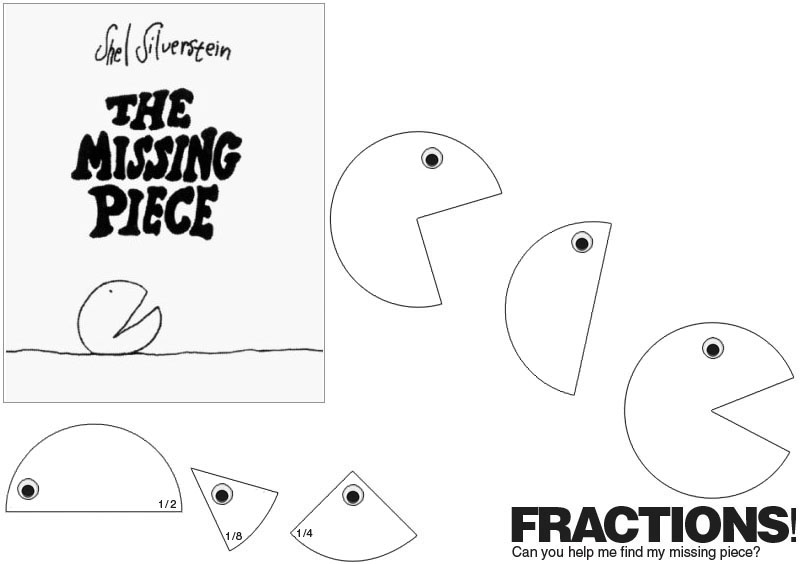
After reading Shel Silverstein's "The Missing Piece," have kids go on a fraction scavenger hunt! Cut out a fraction of a bunch of circles (enough for half of the class) and add a googly eye or make a black dot to represent an eye. Write the fraction on each missing piece and add an eye. Give half of the class a circle that is "looking for its missing piece." Give the other half a missing piece. Kids have to work together to find their match and figure out the fraction of the circle that was missing! Can they do it?!
Note: For older kids, don't write the fraction on the missing piece. See if they can figure it out, using a ruler or by folding their circle!
Subscribe to:
Posts (Atom)